
Troodos Mountains
While Cyprus has amazing beaches and the Mediterranean Sea is indescribable, my favorite part of the island looks inward. The Troodos Mountain range is much larger than one would expect for an island of this size. I guess in a way they remind me of the Smoky Mountains back home. The difference is these mountains have fewer trees and are mostly made of rocks and dirt.

A view of the Troodos Mountians
The roads leading into the mountains are steep, narrow, and winding, and locals tend to cut corners when they drive them. We ventured into these mountains, which are the home of several small villages twice during my time here. The first time we stopped at a little restaurant in the middle of nowhere. We got out of the car and went down to the tables, but not a soul was in sight. We wandered into the unlocked restaurant and looked around but seeing no person or food, we decided they were closed. As we started to leave, a man came running around the corner to stop us and tell us to come back. Lunch here was nice not only because of the great food, but because the air was much cooler than in the city and the view of the hills was spectacular.

This is the little place where we ate lunch
We also stopped to look around a little village; by “little” I mean only 4 people were living there at that time. The first thing we saw was the church. The graveyard was right outside with the tombs facing a scenic vista. Many of the houses were made of mud and straw mixed together to make bricks. They were working on restoring some of the older homes into representations of early life in the villages so we were able to see old looms and wine presses.

A path running through a little mountain village
The next time we went into the mountains, our destination was the Kykkos Monastery. Along the way we stopped at several points of interest including pulling off onto one dirt road that was marked with an arrow that said “hide outs.” This turned out to be a little bunker in the mountain where Cypriot freedom fighters hid during the war of independence. We also stopped at a moufflan enclosure. A moufflan is an animal that I didn’t even know existed. It looks like a sheep, and the males have horns like rams. They are supposed to roam wild in the mountains, but they had some on display for impatient tourists.
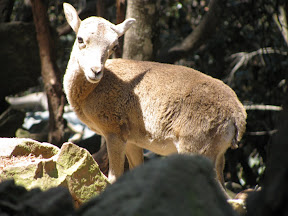
The moufflan look like sheep
When we arrived at the monastery, we were able to walk around the halls and see where the monks lived. Every wall had some kind of mosaic or painting on it. There were pictures of saints and of Bible scenes everywhere. There was a museum that had artifacts thousands of years old. There were books, paintings, robes, pottery, and woodcarvings. The woodcarvings impressed me the most because of the minute detail the monks had put into each scene.

Kykkos Monastery
Our final stop was a little on past Kykkos. Markarios III was the first president of the independent Republic of Cyprus. He was also an archbishop in the church. He started his life as a monk at Kykkos so he said he wanted to be buried in the place he loved. Following the road past Kykkos, you come to a 30-ft black statue marking the tomb of Markarios III. Around his tomb are views of the mountains that he loved. An armed soldier guarded his graveside. Looking out across the mountains near Makarios’ grave, I could see why he wanted to be buried in this place.
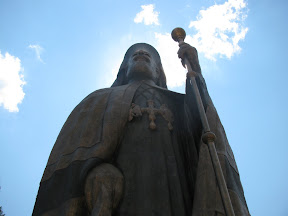
30-ft statue of Makarios III