
A Trip to Famagusta
On Wednesday our group woke up early to catch a bus down to Larnaka. We waited on the main street by the sea for a little while before the big tour bus showed up. We loaded up and picked up a few more tourists before we were on our way to the north side of the island, our destination – Famagusta. We had to stop at the UN checkpoint before crossing the green line. While stopped, we picked up a Turkish Cypriot tour guide. There has to be a Turkish person on board to monitor what the tour guides say about the north. After this harmless lady boarded, our Cypriot tour guide seemed uneasy even though the Turkish lady sat in silence the rest of the time.
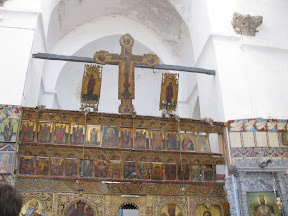
Icons in the museum
Our first stop was the St. Barnabus Archaeological & Icon Museum. This place used to be a church. Since the Turkish occupation, the church could no longer be used for services. Inside there were many pictures of the saints, Mary, and Jesus. Barnabus is the patron saint of Cyprus because he was originally from here before he met up with Paul. Later, it was Paul and Barnabus who brought Christianity to Cyprus.

The church's courtyard was very tranquil.
My favorite part of the church was the outside courtyard. Like most of the churches we have visited, it was beautifully landscaped. The courtyard was surrounded by arches on three sides and in the middle there was a fountain. The sun was shining as a lizard scurried across the stones in front of me.

I saw a couple of lizards.
Our next stop was the ancient ruins at Salamis. Here we were able to catch a glimpse of what was once a prime city in Cyprus as early as 1100 B.C. Huge columns that once made up a gymnasium stood tall next to what at first look seemed like a pile of rubble. Looking closer, individual rooms and houses can be made out. We were free to explore these ruins and I felt very adventurous picking my way over piles of stone. I was happy that these ruins were not roped off to the public like so many other historical treasures are. I was able to walk down paths and touch walls that people 1000 years ago were able to walk and touch. In the middle of all this rubble I saw statues missing limbs, cracked ancient tiles, and mosaics. There was one section that had been baths and seeing the piping system they to fill these tubs amazed me. From the top of the ruins the view of the Mediterranean Sea was spectacular. This site was one of my favorites in Cyprus because of the age of the ruins and the freedom we had to roam around.
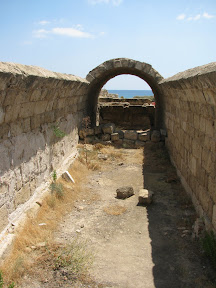
The sea shines through the ruins.
After the ruins, we made it to the city of Famagusta. In 1974 when the Turkish army invaded Cyprus, much of the city was fenced off and now the buildings are old and decrepit. It was sad to see these buildings in this state because they once were the tourist section of town and now everything is falling down. There was a huge mosque in town that we visited; it used to be a cathedral. There were rugs on the floor but the domed sanctuary was mostly empty.

The mosque.
After hanging around town for lunch, we hopped back on the bus and went back to Larnaka where we caught our mini-bus back to Nicosia.